

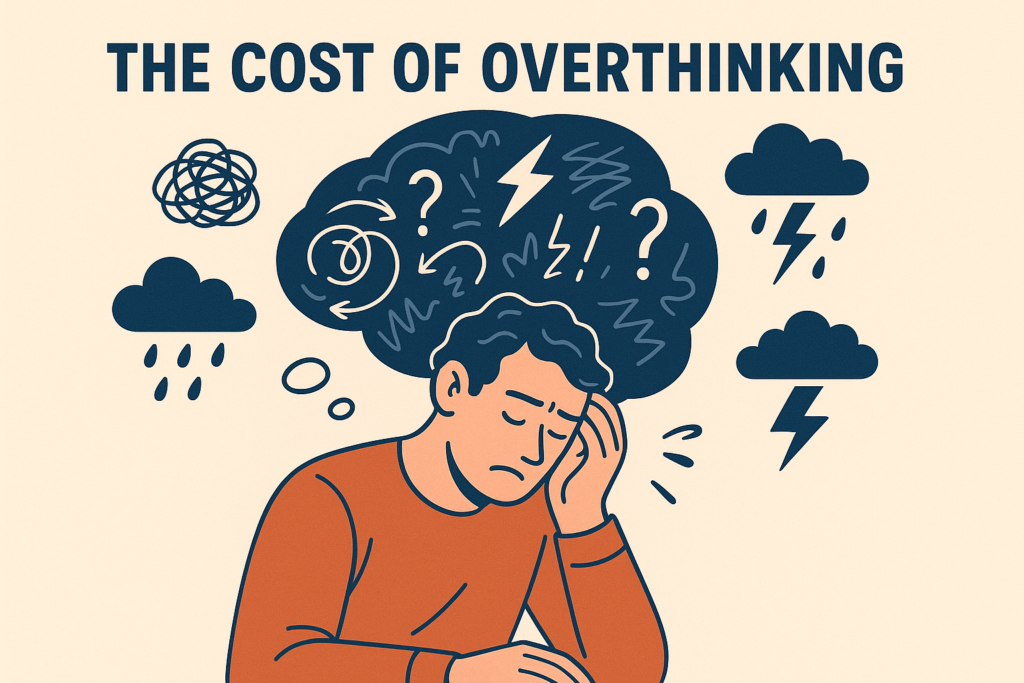
We’ve all been there, lying awake replaying a conversation, worrying about the future, analysing something from every angle. Overthinking can feel like the mind is spinning in circles while the body tenses up, and no amount of “just stop thinking about it” seems to work.
It’s your mind and nervous system caught in a looping cycle created by stress, uncertainty, and neural wiring. When you are not focusing on other work or trying to sleep or relax, your default mode network becomes active.
This network controls:
- self-reflection
- daydreaming
- internal conversations
- mental “time travel” (past and future thinking)
People who often overthink, this network becomes overactive keeping the mind stuck in repetitive internal loops.
Overthinking is often tied to anxiety, and anxiety is tied to amygdala our alarm system of the brain. When the amygdala senses uncertainty or danger (even imagined danger), it triggers:
- heightened stress hormones
- hypervigilance
- worry
- scanning for threats
The prefrontal cortex gets overloaded which is responsible for decision-making and problem-solving. But due to high alert of amygdala the prefrontal cortex gets overwhelmed. Instead of helping it gets stuck, re-analyses, mentally rehearsing or predicting the outcomes.
The brain gets trapped between the fear and outcomes, creating a mental tug of war that fuels the overthinking. Every time you overthink your brain pathways gets more strengthened in the areas of worry, rumination and mental replay. This means the more you do it, the more automatic it becomes.
Overthinking doesn’t just stay in your mind it affects your whole system:
- insomnia or restless sleep
- muscle tension
- stomach issues
- headaches
- irritability
- trouble focusing
This is why overthinking feels exhausting. It’s not “thinking too much” it’s your brain running a full stress program.
How to Calm an Overthinking Brain
Calm Your Nervous System
- Cold splash of water
- Deep breathing
- Stretching
- Walking
Get Thoughts Out of Your Head
- Journaling, voice notes, or talking to someone releases mental pressure and reduces emotional intensity.
- Give yourself 10 minutes a day to think or problem-solve — then close the loop.
It keeps rumination from taking over.
Shift to the External World
- Single-tasking, chores, or sensory grounding move you out of overthinking mode and back into the present.
Overthinking isn’t weakness, it’s the nervous system trying to protect you.
When you support your body, your mind follows.
You break the loop not by thinking less, but by helping your system feel safe again.
Reference
Zhou, H. X., Chen, X., Shen, Y. Q., Li, L., Chen, N. X., Zhu, Z. C., Castellanos, F. X., & Yan, C. G. (2020). Rumination and the default mode network: Meta-analysis of brain imaging studies and implications for depression. NeuroImage, 206, 116287. https://doi.org/10.1016/j.neuroimage.2019.116287
