

Have you ever wondered why your body reacts before your mind catches up?
Like your heart racing in a meeting, shutting down during conflict or feeling safe instantly around certain people? that’s your nervous system speaking.
Polyvagal Theory (PVT), developed by Stephen Porges, explains how our autonomic nervous system (ANS) — the system controlling involuntary functions like heart rate, breathing, digestion — shapes our emotional and survival responses. Rather than seeing the ANS as a simple on/off switch between “calm” vs “stress,” PVT describes a hierarchical system organized through evolution, with different neural circuits influencing how safe or threatened we feel. There are three states:
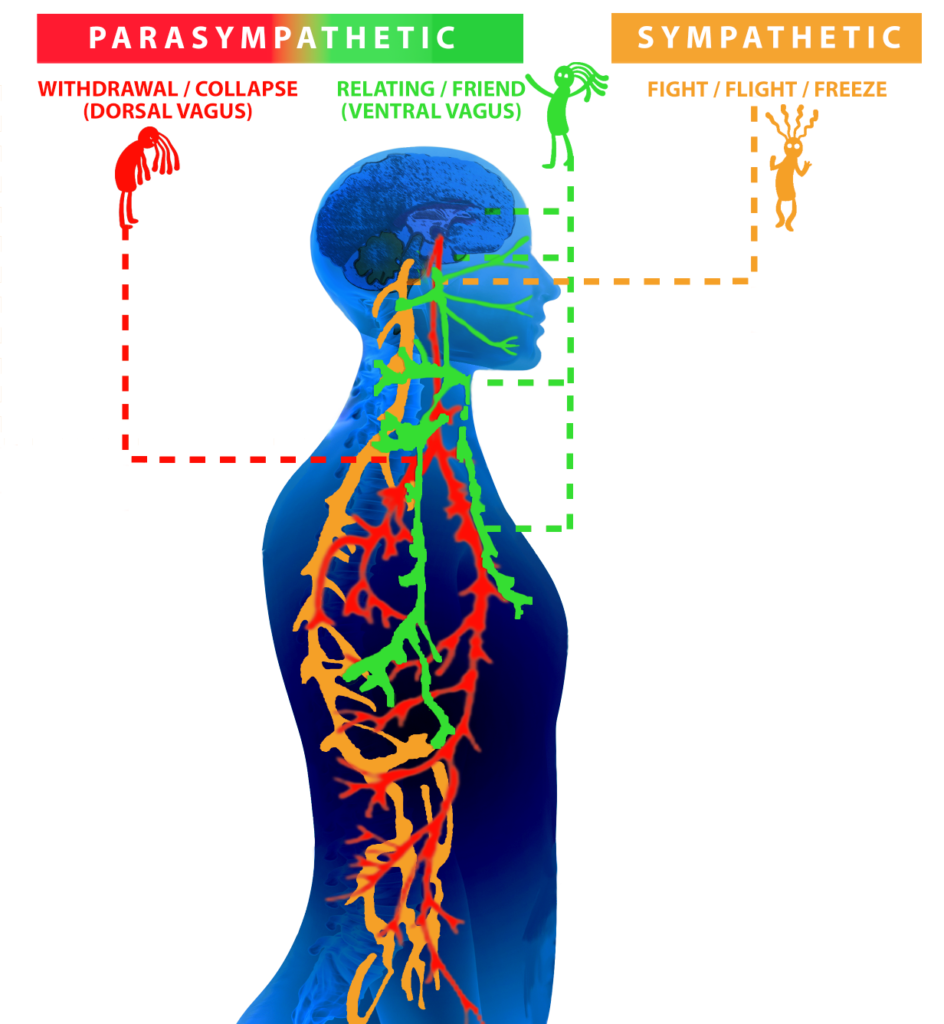
Ventral – when we feel safe or connected makes us feel calm or at ease.
Sympathetic – when we sense stress or danger, increases our heart rate, anxiety and alertness.
Dorsal – freeze or shutdown phase when threat seems impossible, our body becomes numb, exhausted and emotionally collapses.
These aren’t “just anxiety,” they’re the body signalling that something feels unsafe. The same environment can feel different depending on your internal state. A crowded room might feel energizing when safe (ventral), but overwhelming or threatening when stressed (sympathetic or dorsal). This explains why people respond so differently in identical situations.
If emotions are rooted in physiology, then soothing the nervous system means healing the whole system — not just the mind.
- Deep, slow breathing (diaphragmatic or belly breathing): Activates the ventral vagus nerve, promoting calm and safety.
- Grounding through movement, touch, or environment.
- Safe social connection & co-regulation: Being around calm, supportive people helps your system feel safe.
- Reducing overstimulation:Less screen time, lower noise & light, sensory breaks — helps avoid sympathetic overload or dorsal shutdown
In short: PVT is a useful framework, not a rigid rulebook. It helps us understand why our body sometimes acts faster than our thoughts but doesn’t explain everything.
The fear, calm, freeze, connection starts deep inside your nervous system, not just your mind.
Understanding this connection lets us meet our feelings with compassion — not judgment.
Because before you even say a word, your body is already talking.
Reference
Porges S. W. (2009). The polyvagal theory: new insights into adaptive reactions of the autonomic nervous system. Cleveland Clinic journal of medicine, 76 Suppl 2(Suppl 2), S86–S90. https://doi.org/10.3949/ccjm.76.s2.17
