

Have you ever felt any noise, vision or touch feels overwhelming all at once?
For some people that moment isn’t just uncomfortable, it’s called sensory overload. This happens when the brain gets too much input at the same time and can’t filter it. Sounds become louder, surrounding becomes brighter, textures become irritating and focus becomes difficult. For many people with autism, ADHD, anxiety, PTSD, and sensory sensitivities this is a daily reality, it is a neurological response.
People with sensory overload often feel extremely irritable, difficulty focusing, discomfort, extremely excited, urge to cover eyes and ears, etc.
Children with sensory overload, can be a challenge to recognise and treat it. A child who experiences sensory overload doesn’t necessarily should have a condition, it can be due to the brain is adapting and processing the surrounding. If symptoms get worse and the child shows lack of eye contact, speech delay and inability to focus, do consult with a professional or an occupational therapist.
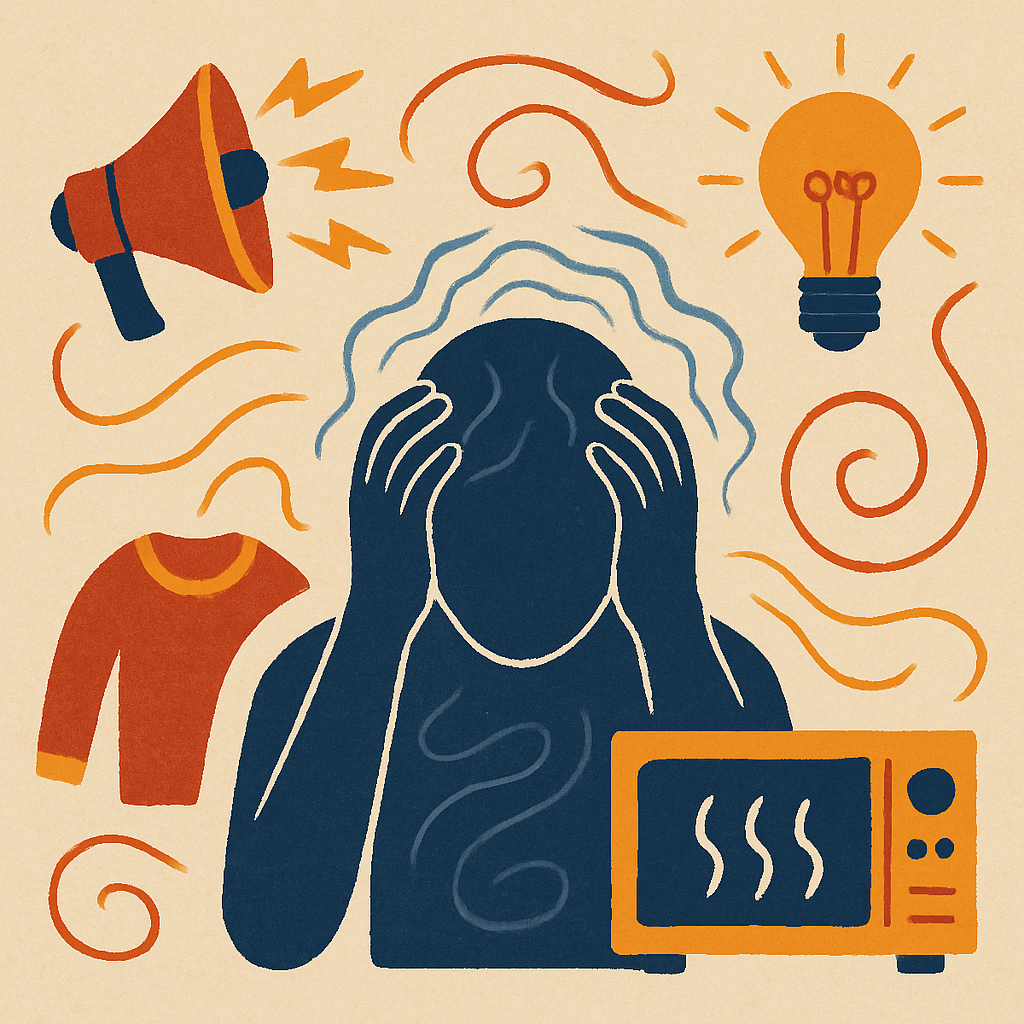
Few common triggers are:
- Crowded places
- Bright lights
- Strong smells
- Stress or multitasking
What helps:
- Noise-cancelling headphones
- Softer lighting
- Stepping away to a quiet place
- Breathing and grounding work
- Patience and space from other
The most supportive thing you can offer is understanding without judgement. Be mindful and respect their space, sensory overload is real and valid.
REFERENCE
Butcher, L., & Lane, S. (2025). Neurodivergent (autism and ADHD) student experiences of access and inclusion in higher education: An ecological systems theory perspective. Higher Education, 90, 243–263. https://doi.org/10.1007/s10734-024-01319-6
